As an adult, it’s easy to forget or overlook that “listen to this book” or “listen to your body” can so easily be received as “sit still and pay attention” or “eat your food”!
But somehow, “I’m going to read this book while your lunch is out” transforms the social, developmental, and physical demands of sharing a mealtime with peers and attending to a book into a powerful opportunity for regulating and world-building together.
So many educators feel like absolute geniuses when they discover for themselves the potent alchemy of reading stories to children while they are eating, and they should.
For myself, I feel protective of providing children with calm and connected opportunities to fuel their bodies while feeding their imaginations.

Eating is a challenge for so many of us—kids and adults alike—for so many reasons. Just to name a few that I observe over and over again with children and that I personally experience: neurodivergent hyperfocus that makes switching between tasks unpleasant/impossible, social anxiety, general squirliness.
I love communal eating rituals at school as an opportunity to model for kids my own difficulties switching what I’m doing, my commitment to taking care of my body, and my genuine pleasure reading to them and experiencing their reactions.
I feel particularly fortunate that this year’s group of kindergarteners are especially exuberant about their love of books and stories. I can’t wait to see what shared background knowledge, references, and touchstones we build together this year.
Teacher Quinn’s recommended reading
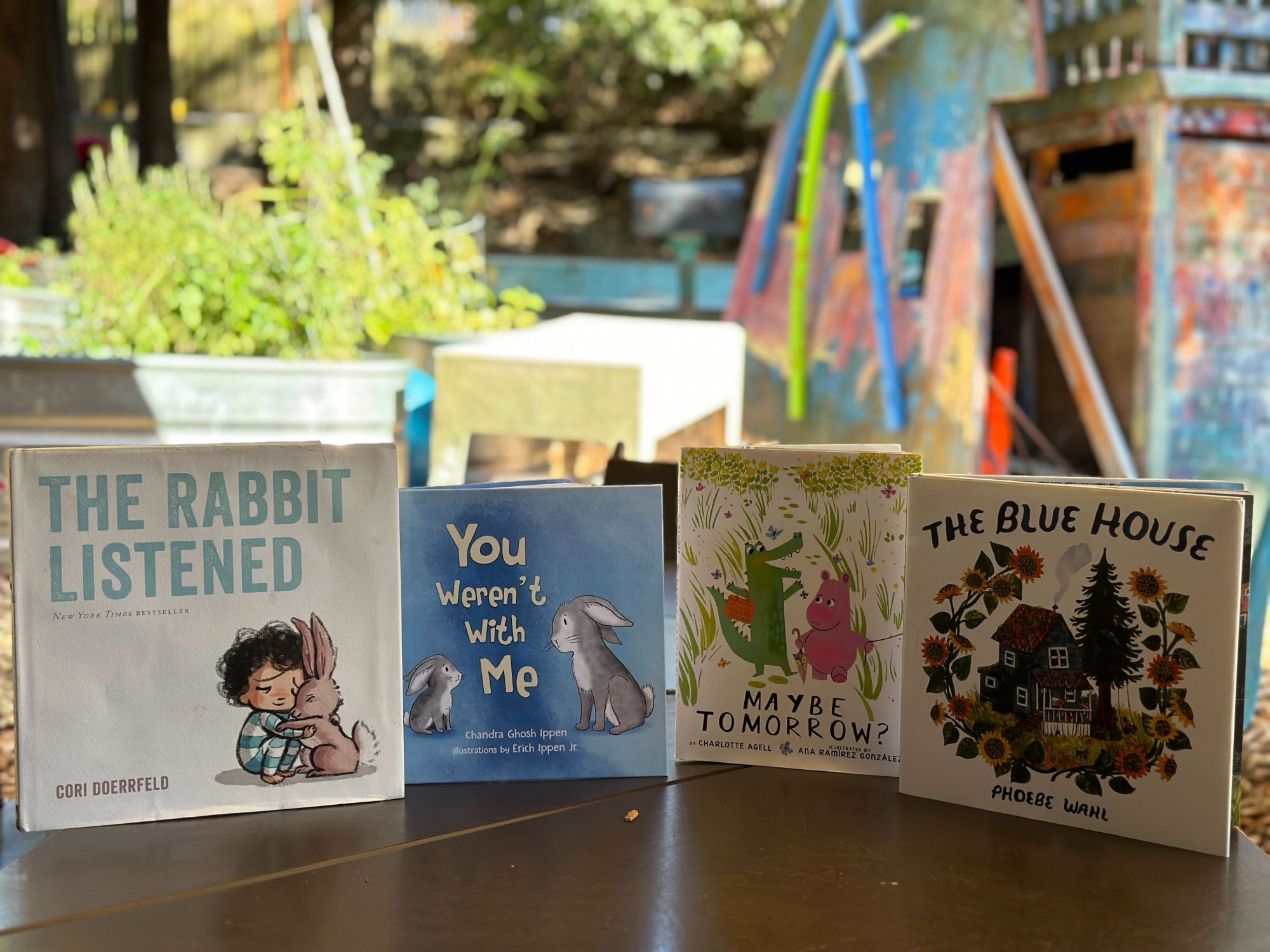
These are some books we’ve read together that both kids and adults have particularly enjoyed. All of them involve characters holding space for loved ones experiencing or processing a difficult time.
As someone trusted with the big feelings of children, I value these characters as models for how to listen and affirm without minimizing the role I often play in children’s big feelings.

The Blue House, by Phoebe Wahl
I haven’t confirmed, but I’m pretty sure Phoebe Wahl is on the short list of things that make my partner feel patriotic (see also Martina McBride’s “Independence Day” and Taco Bell). This book welcomes readers into the dense coziness and thick felt safety of the blue house Leo shares with his dad—just in time to learn alongside Leo that their home is going to be demolished, and that they will have to move. The text and pictures move everyone through how this parent guides his child through this change.
You Weren’t With Me, by Chandra Ghosh Ippen, illustrated by Erich Ippen Jr.
Early child educators are cautioned—with good reason—to be aware of important aspects of their classroom libraries. Specifically, it is important that all children experience the pleasure of seeing children who look like them in books and the affirmation that children like them deserve to be central characters in the stories that ground our learning communities.
This book, starring Little Rabbit and Big Rabbit, does no such diversity, equity, and inclusion work. It is, however, arguably one of the few books in which the animalness of the characters successfully holds space for the multiplicity of identities that might identify with the crux of the conflict in the book: there was an unspecified period of time, for unspecified reasons, when Big Rabbit was not with Little Rabbit, and even though they are together again, Little Rabbit is still processing that experience of withoutness.
Truly sensitive and unwaveringly insistent on emotional and somatic realities rather than feel-good solutions, this book offers many different adults wonderfully helpful scripts for holding space and staying present after an absence.
But wait, two more books with animals as main characters that I swear are worth it for the power of the social-emotional truths that they tell:
The Rabbit Listened, by Cori Doerrfeld
Taylor builds a truly astonishing tower when out of nowhere, UNIDENTIFIED AND DESTRUCTIVE BIRDS! Arguably even worse, Taylor is then inflicted with a whole menagerie of animals offering their trademarked solution to the disappointing situation (Snake: Let’s knock over someone else’s).
What a relief, then, when the Rabbit listens, and in doing so provides the space and co-regulation needed for Taylor to be able to move through the devastation.
Maybe Tomorrow? by Charlotte Agell, illustrated by Ana Ramírez González
Elba, a hippopotamus, drags a big black box behind her by a string everywhere she goes. Norris, an ambiguous reptilian creature that perhaps a herpetologist could identify, keeps showing up for her: inviting her on outings, asking her questions, and eventually grieving a friend with her.
I love that Elba and the book make it so clear that her grief will never not be a part of her, and I love that the big black box does in fact get smaller—not because it should, and not because it is more trivial or less profound than Elba realized, but because that is in fact what happens when others share in our mourning.
If you are interested in enrollment in our Kindergarten class, find out more here.
 Teacher Quinn is our Kindergarten teacher. Quinn previously worked supporting students receiving special education services as a paraeducator. They have a Master’s in Education from the University of Washington with a focus on High-Incidence Disabilities. Quinn is also a licensed foster parent and a bio parent.
 Woodland Park Cooperative School
Such a creative idea! Teacher Quinn’s lunchtime book report is a fun and engaging way to encourage reading. A great example of how to make learning enjoyable for kids!